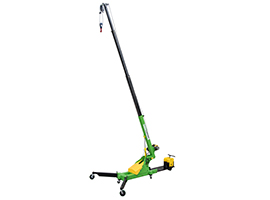


Mini Cranes: The Hidden Gem You Want in Your Tool Chest
p>Microcranes® provides compact mini crane solutions for Texas contractors, industrial facilities, aviation maintenance teams, utilities, warehouses, manufacturers, property owners, and facility maintenance crews that need practical lifting equipment in tight or restricted access areas.
Across Texas, lifting work is not limited to open construction sites. Many jobs happen inside active buildings, plants, aircraft hangars, rooftops, warehouses, service corridors, mechanical rooms, water treatment facilities, data centers, hospitals, schools, apartment buildings, and industrial maintenance areas where larger cranes, forklifts, telehandlers, and boom trucks may not fit.
Microcranes® is built for these real-world material handling problems.
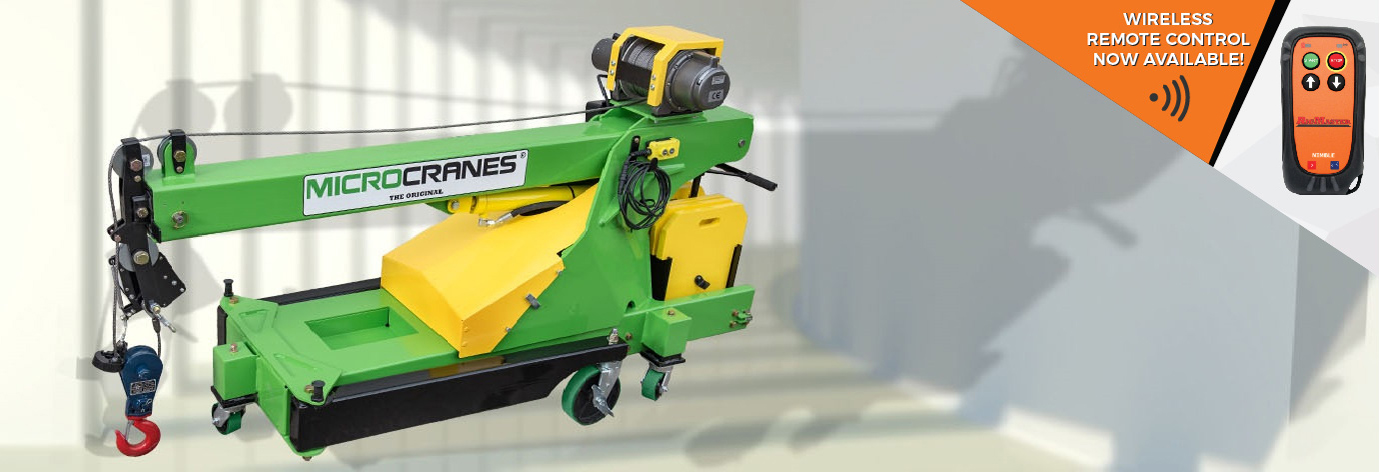
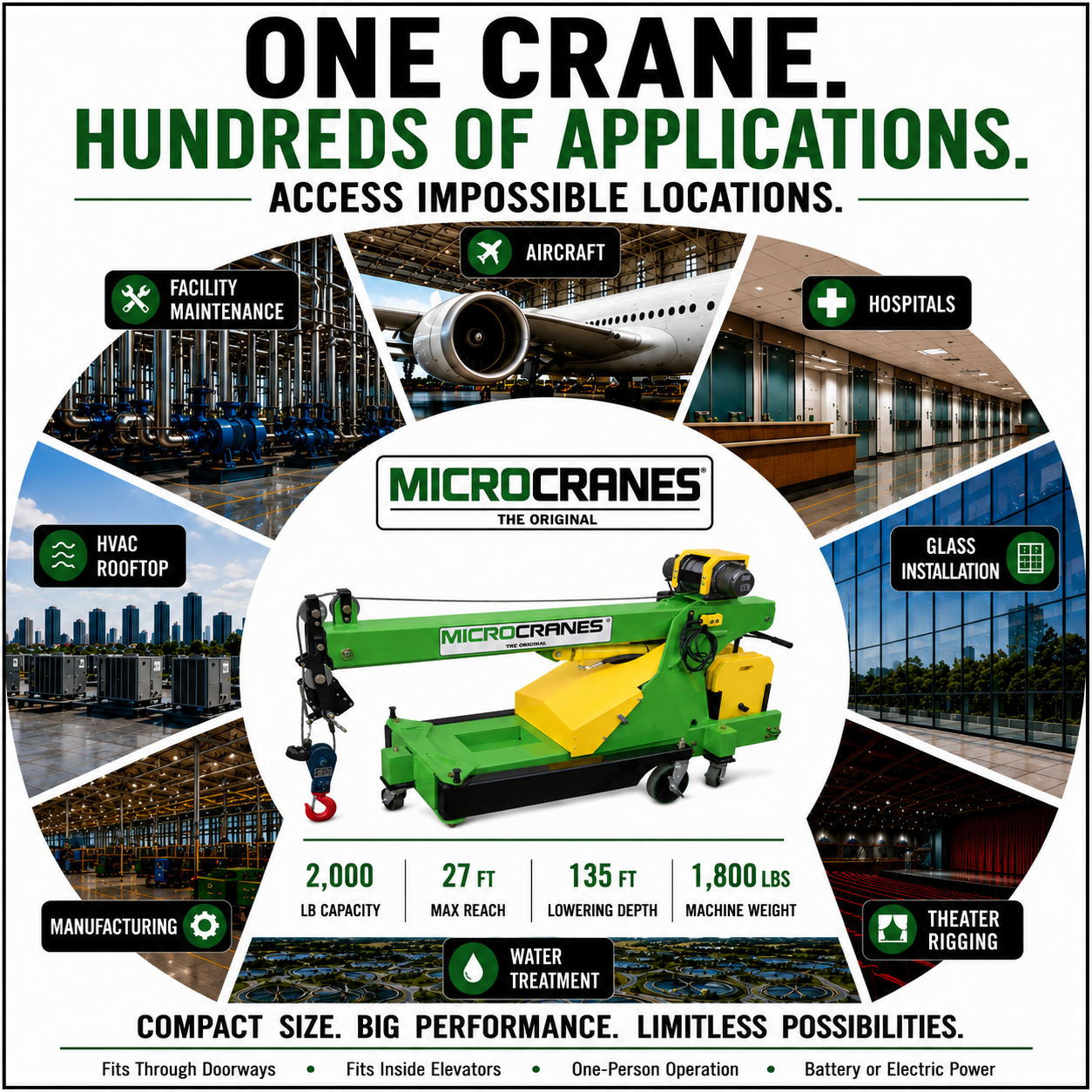
With up to 2,000 lb lifting capacity, up to 27 ft lifting height, battery or 115V electric operation, compact access, non-marking wheels, pick-and-carry capability, and precision variable-speed control, Microcranes® gives Texas crews a portable lifting solution for jobs that are too heavy for manual handling, too tight for forklifts, and too small or inconvenient for full crane rental.
Microcranes® is designed to bring controlled lifting power closer to the work.
Portable Mini Cranes for Texas Jobsites and Facilities
Texas has one of the broadest industrial and construction markets in the country. A single state page needs to speak to many different buyers: commercial contractors, mechanical contractors, glazing contractors, energy facilities, aerospace companies, aircraft maintenance teams, water treatment plants, warehouses, data centers, hospitals, schools, property managers, utilities, and manufacturing operations.
Microcranes® fits these markets because it is not a single-trade machine. It is compact portable material handling equipment for lift points that are difficult to reach with conventional equipment.
Typical Texas applications include:
- HVAC equipment handling
- Rooftop material lifting support
- Mechanical room equipment placement
- Glass and glazing support
- Steel and miscellaneous metals installation
- Pump, motor, compressor, and valve handling
- Facility maintenance lifting
- Warehouse and plant equipment movement
- Water and wastewater plant maintenance
- Apartment and property maintenance
- Data center and mission critical equipment handling
- Energy, utility, and infrastructure support
- Aircraft maintenance equipment handling
- Aviation MRO material handling
- Aircraft hangar lifting support
- Aerospace component handling
- Ground support equipment maintenance
- Indoor construction and renovation work
Microcranes® is not just a smaller crane. It is a practical lifting tool for crews that need crane utility without the size, mobilization cost, or access limitations of larger machines.
Mini Cranes in Houston, Dallas-Fort Worth, Austin, San Antonio, and Across Texas
Microcranes® supports lifting applications throughout Texas, including Houston, Dallas, Fort Worth, Austin, San Antonio, El Paso, Corpus Christi, Midland-Odessa, Waco, Lubbock, Amarillo, Beaumont, the Gulf Coast, and smaller industrial and commercial markets across the state.
Houston buyers often need compact lifting equipment for refineries, petrochemical facilities, energy sites, water treatment plants, port-related maintenance, hospitals, high-rise buildings, and commercial construction. A portable mini crane can help move pumps, motors, valves, HVAC components, panels, and equipment inside facilities where large cranes or forklifts may not be practical.
Dallas-Fort Worth buyers often use portable cranes for warehouses, logistics facilities, aviation maintenance, aerospace support, data centers, commercial buildings, industrial service, and facility maintenance. The DFW market has many large buildings and active facilities where compact indoor lifting equipment can reduce delays and improve equipment handling.
Austin and Central Texas applications may include technology campuses, data centers, semiconductor-related facilities, universities, hospitals, apartment buildings, mechanical contractors, and commercial property maintenance. In these environments, clean battery or electric operation and compact access can be valuable.
San Antonio applications may include military support facilities, aerospace and aviation maintenance, hospitals, schools, manufacturing facilities, utilities, and commercial building maintenance.
West Texas and Gulf Coast applications may include energy, utilities, wind, solar, oil and gas support, water infrastructure, plant shutdowns, and remote facility maintenance where having compact lifting capability available can save time.
Wherever the job is located, the challenge is often the same: the load may be manageable, but access to the lift point is difficult.
Why Texas Contractors Use Portable Mini Cranes
Texas projects often move fast. Crews need lifting equipment that can be deployed without turning a smaller material handling task into a major logistics event.
A short pick inside a building, an equipment replacement in a plant, a rooftop component move, an aircraft hangar maintenance task, or a warehouse equipment repair can become expensive when the only available options are a large crane, a forklift that cannot reach, a gantry that takes time to assemble, or too many workers moving something by hand.
Microcranes® helps solve that gap.
A compact mini crane can reduce the amount of equipment, labor, and coordination needed for many controlled lifting tasks. Instead of coordinating a boom truck, blocking access, waiting for crane availability, or improvising with manual handling, crews can use a portable crane with a smaller footprint and controlled movement.
Key advantages include:
- 2,000 lb lifting capacity
- Up to 27 ft lifting height
- Battery or 115V electric operation
- Zero-emission operation at the point of use
- Compact access for tight areas
- Pick-and-carry capability where appropriate
- Precision movement for controlled placement
- Non-marking wheels for finished surfaces
- Lower machine weight than many larger alternatives
- Fast setup for repeat lifts and service work
- Useful for contractors, plants, warehouses, hangars, and facility teams
For many Texas buyers, the value is not only the crane capacity. The value is having lifting capability available when the job is too small for a full crane rental but too heavy, awkward, or risky for manual handling.
Texas Industries Served
Microcranes® can be used across many Texas industries where compact material handling equipment is needed.
Common markets include:
- Commercial construction
- Mechanical contracting
- Glazing and glass installation
- Industrial maintenance
- Manufacturing
- Warehousing and logistics
- Data centers and mission critical facilities
- Water and wastewater treatment
- Utilities and infrastructure
- Oil and gas support
- Petrochemical and process facilities
- Renewable energy support
- Aviation maintenance
- Aircraft hangars
- Aerospace facilities
- Military and defense support facilities
- Hospitals and healthcare facilities
- Schools and universities
- Apartment and property maintenance
- Municipal facilities
- Facility management departments
This broad use is what makes Microcranes® different from equipment designed for only one trade. One crane platform can support many departments, many job types, and many repeat lifting problems.
Aircraft Maintenance and Aviation MRO Lifting Equipment in Texas
Texas has a strong aviation, aerospace, airport, defense, and MRO presence. Aircraft maintenance teams often need controlled lifting equipment for hangar work, tooling movement, component handling, support equipment placement, and facility maintenance.
Microcranes® can serve as a compact aviation maintenance crane for material handling tasks where clean operation, precise movement, non-marking wheels, and restricted access matter.
Aircraft maintenance and aviation MRO applications may include:
- Aircraft component handling
- Engine accessory handling
- Tooling movement
- Ground support equipment maintenance
- Hangar material handling
- Aerospace facility maintenance
- Panel and equipment positioning
- Pump, motor, and compressor handling
- Maintenance support equipment handling
- Parts and fixture movement
- Airport facility maintenance
- Aviation support equipment placement
Aircraft hangars and MRO facilities often require equipment that can work around valuable aircraft, finished floors, tooling, maintenance stands, and active operations. A large forklift or fuel-powered machine is not always the best fit for controlled material handling in these environments.
Microcranes® gives aviation maintenance teams a portable lifting option for aircraft maintenance equipment handling, aviation MRO lifting, aircraft component handling, tooling movement, hangar material handling, and aerospace facility maintenance.
Microcranes® is intended for materials only. It is not a personnel lift and is not used to lift people.
Industrial Maintenance and Plant Lifting Applications
Texas industrial facilities often need lifting equipment for maintenance, repair, shutdowns, upgrades, and equipment replacement. A load may only weigh a few hundred pounds, but the lift point may be inside a tight room, behind other equipment, across a finished floor, or far from forklift access.
Microcranes® can assist with controlled handling of:
- Pumps
- Motors
- Valves
- Compressors
- Gearboxes
- Electrical cabinets
- Control panels
- Filtration equipment
- Tooling
- Replacement parts
- Small skids
- Mechanical components
- Maintenance equipment
For plant maintenance teams, the advantage is speed and access. Instead of waiting for outside lifting equipment or assigning multiple workers to a difficult move, a compact crane can be brought closer to the work area.
This can help reduce downtime, improve control, and make repeat maintenance tasks easier to manage.
Mini Crane Alternative to Forklifts, Boom Trucks, and Large Crane Rentals
A forklift is useful when there is open space, proper surface conditions, and a clear travel path. A boom truck is useful when the lift can be reached from outside. A full-size crane may be necessary for heavy or high-capacity lifting.
But many Texas jobs do not fit those conditions.
A Microcranes® unit may be a better fit when:
- The lift is indoors
- Access is limited
- A forklift cannot reach the pick point
- A boom truck cannot get close enough
- The work area is too tight for larger equipment
- The lift is repeated over multiple jobs
- Battery or electric operation is required
- Finished floors or clean environments matter
- The crew needs controlled placement rather than bulk material movement
- The job does not justify a full crane rental
- Equipment must move through doors, corridors, elevators, hangar aisles, service areas, or tight plant access routes
This makes Microcranes® valuable for both contractors and owners. Contractors can reduce delays and improve lift efficiency. Owners and facility teams can keep lifting capability available for maintenance, upgrades, emergency equipment replacement, and repeat material handling work.
Texas Lifting Problems Microcranes® Helps Solve
Many buyers do not start by searching for “mini crane.” They search for the problem they need to solve.
Microcranes® helps answer questions like:
- How do I lift heavy equipment inside a building?
- What can I use instead of a forklift in a tight space?
- How do I move equipment through a doorway or service corridor?
- What crane can be used inside a warehouse or plant?
- How do I lift HVAC equipment on a rooftop?
- What equipment helps with aircraft hangar material handling?
- How do I move pumps, motors, valves, and compressors safely?
- What is a compact crane for facility maintenance?
- What lifting equipment works indoors without diesel exhaust?
- How do I lift material in a data center, plant, hangar, or mechanical room?
- What equipment can help reduce manual material handling?
- What portable crane can support repeat maintenance work?
Microcranes® is designed for these practical lifting situations where access, control, and deployment matter as much as rated capacity.
Built for Practical Jobsite Access
One of the biggest advantages of Microcranes® is access. Many lifting problems are not caused by the weight of the object alone. They are caused by the path to the object.
The lift may require equipment to move through a doorway, across a finished floor, into a service room, around machinery, onto an elevator, through an aircraft hangar, across a rooftop, or through a tight construction area. Large machines may have the capacity, but they may not be able to reach the work.
Microcranes® is designed for restricted access lifting. It gives Texas crews a compact crane that can be positioned closer to the work area and used for precise handling in spaces where larger equipment becomes inefficient.
This can be especially important for:
- Interior construction
- Tenant improvements
- Mechanical and electrical upgrades
- Equipment replacement
- Plant shutdown work
- Building maintenance
- Rooftop access support
- High-rise service work
- Utility and infrastructure maintenance
- Aircraft hangar maintenance
- Aviation MRO facilities
- Finished building environments
- Warehouse maintenance areas
- Data center equipment rooms
The goal is simple: bring lifting power closer to the work.
Battery and Electric Mini Crane Operation
Microcranes® is available with battery or 115V electric operation, making it useful for indoor and enclosed environments where gas or diesel-powered equipment may not be appropriate.
Battery and electric operation can help reduce noise, fumes, and jobsite disruption. This is important in active buildings, industrial facilities, hospitals, schools, commercial properties, aircraft hangars, airport facilities, data centers, clean work environments, and facilities where emissions and ventilation are concerns.
For Texas contractors and facility teams, electric lifting equipment can also simplify deployment. Instead of relying only on larger fuel-powered machines, crews can use compact lifting equipment designed for controlled material handling in practical work areas.
Warehouse, Logistics, and Facility Maintenance Lifting
Texas has major warehouse and logistics activity, especially around Dallas-Fort Worth, Houston, Austin, San Antonio, border trade corridors, and large industrial parks.
Warehouses and logistics facilities often need equipment moved, serviced, replaced, or installed without disrupting the entire operation. Forklifts are useful for pallet movement, but they are not always ideal for vertical lifting, controlled placement, or tight equipment access.
Microcranes® can help with:
- Conveyor maintenance
- Motor replacement
- Dock equipment service
- Overhead door components
- Packaging equipment
- Rack-area maintenance
- Mezzanine-related lifting
- Compressor and pump handling
- Facility repair work
- Small machinery placement
- Equipment replacement in tight service areas
The goal is to bring crane utility into the facility without turning every maintenance task into a major mobilization.
Data Center and Mission Critical Equipment Handling
Texas continues to attract major technology, cloud, data center, power, and mission critical infrastructure projects. These facilities often require clean, controlled equipment movement in sensitive environments.
Microcranes® can support material handling in and around:
- Data halls
- Electrical rooms
- Battery rooms
- Generator support areas
- Mechanical spaces
- Switchgear rooms
- Cooling equipment areas
- Facility maintenance zones
- Equipment staging areas
Because Microcranes® can operate on battery or electric power, it is well suited for indoor and low-emission environments where diesel exhaust, noise, and large machine access are concerns.
For Texas data center contractors and facility teams, the value is not just lifting capacity. It is controlled movement, compact access, and practical deployment.
Rooftop and High-Rise Material Handling Support
Texas cities continue to grow vertically, and many buildings require maintenance, upgrades, and equipment handling above ground level. Rooftop lifting often creates access challenges. The material may need to be moved through a building, up an elevator, across a roof, or into a tight mechanical area.
Microcranes® can support rooftop and high-rise material handling when the lift plan, access path, floor loading, and jobsite conditions are appropriate. Its compact size and electric operation make it useful for controlled material movement in environments where larger lifting equipment may be difficult to use.
Common rooftop-related tasks may include:
- HVAC component handling
- Mechanical equipment replacement
- Material staging
- Maintenance support
- Equipment positioning
- Rooftop construction assistance
- Controlled lifting near restricted access areas
All rooftop and elevated lifting work should be reviewed for surface conditions, load path, bearing pressure, wind, slope, access, and site-specific safety requirements.
Mini Cranes for Texas Glazing, Mechanical, Aviation, and Specialty Trades
Microcranes® can help specialty contractors reduce manual handling and improve control during installation and maintenance work. Glazing, mechanical, HVAC, steel, signage, millwork, industrial service, aviation maintenance, aerospace support, and facility maintenance trades often handle materials that are heavy, awkward, fragile, or difficult to position.
A compact crane gives these crews a controlled lifting tool for jobs where manpower alone is inefficient or unsafe. The ability to lift, position, and move materials with precision can help crews complete work more efficiently while reducing unnecessary strain.
For Texas glazing contractors, Microcranes® can assist with glass and panel handling support where appropriate attachments and site planning are used. For mechanical contractors, it can help position equipment in mechanical rooms, rooftops, plants, and commercial buildings. For aviation maintenance teams, it can assist with aircraft component handling, hangar material handling, tooling movement, and aerospace facility maintenance. For maintenance teams, it can help with recurring equipment handling problems.
Why Buy Instead of Renting a Crane for Every Small Lift?
Crane rental has its place. For large lifts, high-capacity lifts, or jobs requiring specialized operators and heavy equipment, rental may be the correct solution.
But many smaller material handling jobs happen repeatedly. A contractor may face the same lifting challenge on job after job. A facility may need to replace equipment several times per year. An aviation maintenance department may need lifting capability for tooling, parts, and support equipment. A maintenance team may need lifting capability without waiting for outside scheduling.
Owning a Microcranes® unit can make sense when:
- Lifting needs are recurring
- Small crane rentals are difficult to schedule
- Downtime is expensive
- Crews frequently handle heavy materials
- Jobsites have tight access
- Indoor lifting is common
- Aircraft hangar or facility maintenance lifting is recurring
- Multiple departments can use the same crane
- The crane can be used across many projects
- The company wants more control over small lifts
The return is often found in time savings, reduced labor strain, faster response, better control, and fewer oversized equipment solutions for smaller lifts.
Texas Mini Crane Buyer Questions
Before choosing a mini crane, Texas buyers should consider:
- What is the maximum load weight?
- How high does the material need to be lifted?
- How far must the crane reach?
- Will the work be indoors, outdoors, or both?
- Does the equipment need to fit through doors or elevators?
- Will the crane be used in a plant, warehouse, hangar, rooftop, or active facility?
- Is battery or electric operation required?
- Will the crane be used on finished floors?
- Are there rooftop or elevated access requirements?
- Will the crane be used by one crew or multiple departments?
- Is the need occasional or recurring?
- Are there site-specific floor loading or ground pressure limits?
- What attachments or rigging tools are required?
- Is the crane being used for general construction, facility maintenance, aviation maintenance, or industrial support?
Microcranes® can help buyers evaluate whether a compact mini crane is the right fit for the job.
Texas Mini Crane FAQs
What is a mini crane used for in Texas?
A mini crane is used for compact material handling, equipment placement, rooftop lifting support, facility maintenance, aircraft hangar work, industrial maintenance, warehouse equipment handling, and restricted access lifting where larger cranes or forklifts may not fit.
Can Microcranes® be used indoors?
Yes. Microcranes® is available with battery or 115V electric operation, making it useful for indoor material handling, warehouses, plants, hangars, hospitals, schools, data centers, and active commercial facilities.
Is Microcranes® useful for aircraft maintenance?
Yes. Microcranes® can support aircraft maintenance equipment handling, aviation MRO lifting, aircraft component handling, tooling movement, hangar material handling, ground support equipment maintenance, and aerospace facility maintenance. It is for materials only, not personnel lifting.
What is the lifting capacity of Microcranes®?
Microcranes® offers up to 2,000 lb lifting capacity, depending on configuration, lift radius, setup, and jobsite conditions.
How high can Microcranes® lift?
Microcranes® offers up to 27 ft lifting height, making it useful for many indoor, rooftop, maintenance, and facility lifting tasks.
Can a portable mini crane replace a forklift?
A mini crane does not replace every forklift application, but it can be a better fit when the job requires vertical lifting, controlled placement, compact access, or material handling in tight areas where a forklift cannot reach.
Is Microcranes® only for contractors?
No. Microcranes® can be used by contractors, facility maintenance teams, plant operators, utilities, warehouses, aviation maintenance teams, aerospace facilities, property owners, and industrial service companies.
Related Microcranes® Pages
- Aircraft Maintenance Crane
- Material Handling Equipment
- Rooftop Lifting Equipment
- Industrial Maintenance Crane
- Battery Powered Mini Crane
- Mini Crane Buyer’s Guide
- Water Treatment Maintenance Crane
- Glazing Crane
- Request a Lift Review
Microcranes® for Texas
Microcranes® is built for practical lifting in real jobsite conditions. It is compact, portable, electric or battery powered, and designed to help crews handle materials in places where larger equipment may not be efficient.
For Texas contractors, industrial facilities, utilities, property owners, maintenance teams, aviation MRO facilities, aircraft maintenance teams, aerospace contractors, warehouses, data centers, and specialty trades, Microcranes® provides a flexible lifting solution for restricted access work, indoor lifting, rooftop support, equipment replacement, aircraft hangar material handling, and everyday material handling.
When the job is too tight for a forklift, too small for a full crane rental, too heavy for manual handling, or too important to delay, Microcranes® helps bring controlled lifting power closer to the work.
Microcranes®
Adaptive Material Handling™
2,000 lb capacity. 27 ft lifting height. Lightweight. Portable. Ready in minutes.
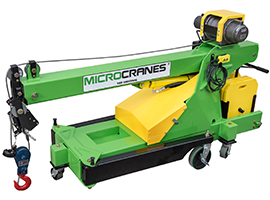
Compact Crane
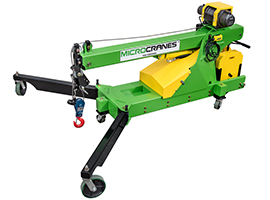
Outrigger Legs
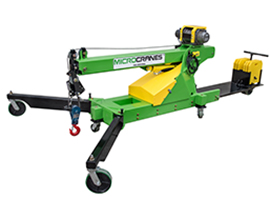
Counterweight Extended