

Adaptive Material Handling™ for Warehouses, Distribution Centers, Manufacturing, and Industrial Facilities
Material handling equipment is the backbone of modern industry. Every warehouse, distribution center, manufacturing plant, hospital, utility, airport, commercial building, and industrial facility depends on material handling solutions to move products, equipment, inventory, materials, tools, and critical assets safely and efficiently.
From forklifts and pallet jacks to conveyors, robotics, storage systems, hoists, and cranes, material handling equipment keeps operations running.
Yet despite tremendous advances in automation, robotics, artificial intelligence, and warehouse technology, one challenge remains unchanged:
Something heavy always needs to be lifted.
A motor fails. A pump must be replaced. A conveyor gearbox reaches the end of its service life. An HVAC unit must be installed. A robotic system requires maintenance. A machine must be relocated. A piece of equipment must be lowered into a pit, shaft, rooftop opening, or utility structure.
These are the lifting challenges that stop production, delay projects, create downtime, and frustrate maintenance teams.
At Microcranes®, we believe these challenges require a different approach.
We call it Adaptive Material Handling™.
Adaptive Material Handling™ is the ability to lift, transport, lower, position, install, relocate, and support materials wherever the work happens — not just where traditional material handling equipment can reach.
It is flexible. It is mobile. It is responsive. It is practical. And it is built around one simple idea:
Every facility needs an Everyday Crane™.
What Is Material Handling Equipment?
Material handling equipment includes the machines, systems, tools, technologies, and lifting devices used to move, position, transport, protect, store, control, and manage materials throughout a facility or supply chain.
Examples of material handling equipment include forklifts, reach trucks, pallet jacks, order pickers, conveyors, lift tables, material lifts, industrial carts, shelving systems, storage racks, automated storage systems, autonomous mobile robots, automated guided vehicles, hoists, gantry cranes, jib cranes, bridge cranes, vacuum lifters, manipulators, robotic picking systems, palletizers, depalletizers, portable lifting equipment, mobile lifting equipment, and industrial lifting equipment.
Each solution performs an important role. Forklifts move pallets. Conveyors move products. Robots move inventory. Storage systems organize materials. Hoists and cranes lift loads in defined areas.
But many organizations eventually discover a critical gap.
They have equipment designed to move products. They do not always have equipment designed to move the machines, tools, parts, and infrastructure that keep the facility operating.
The Hidden Gap in Most Material Handling Systems
Walk through almost any warehouse, manufacturing plant, utility, hospital, data center, or distribution center and you will find forklifts, pallet jacks, conveyors, robotics, storage systems, warehouse equipment, inventory systems, and material transport devices.
Yet when a maintenance emergency occurs, many facilities are suddenly forced to improvise.
The forklift cannot reach. The pallet jack cannot lift. The robot is not programmed for the task. The conveyor cannot help. The overhead crane is located elsewhere. A rental crane must be scheduled. Contractors must be called. Downtime begins.
This is where Adaptive Material Handling™ changes the equation.
Microcranes® help fill the gap between basic material movement and full-scale crane service. They give facilities a compact, portable lifting system that can move to the work, lift the load, carry the load, position the load, and support the job without waiting for outside equipment.
Why Every Facility Needs an Everyday Crane™
Forklifts are designed for pallets. Conveyors are designed for product flow. Robots are designed for repetitive tasks. Storage systems are designed for organization.
Microcranes® are designed for the unexpected.
An Everyday Crane™ is available when equipment fails, production stops, motors require replacement, pumps need service, HVAC systems need installation, robotics need maintenance, electrical equipment must be positioned, conveyors require upgrades, and facility projects need lifting support.
An Everyday Crane™ is not rented. It is not scheduled weeks in advance. It is not sitting on another jobsite.
It is already there.
Ready to work. Ready to lift. Ready to solve problems.
Meet Microcranes®
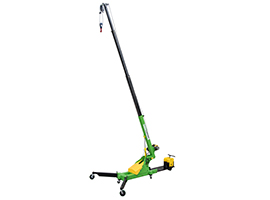
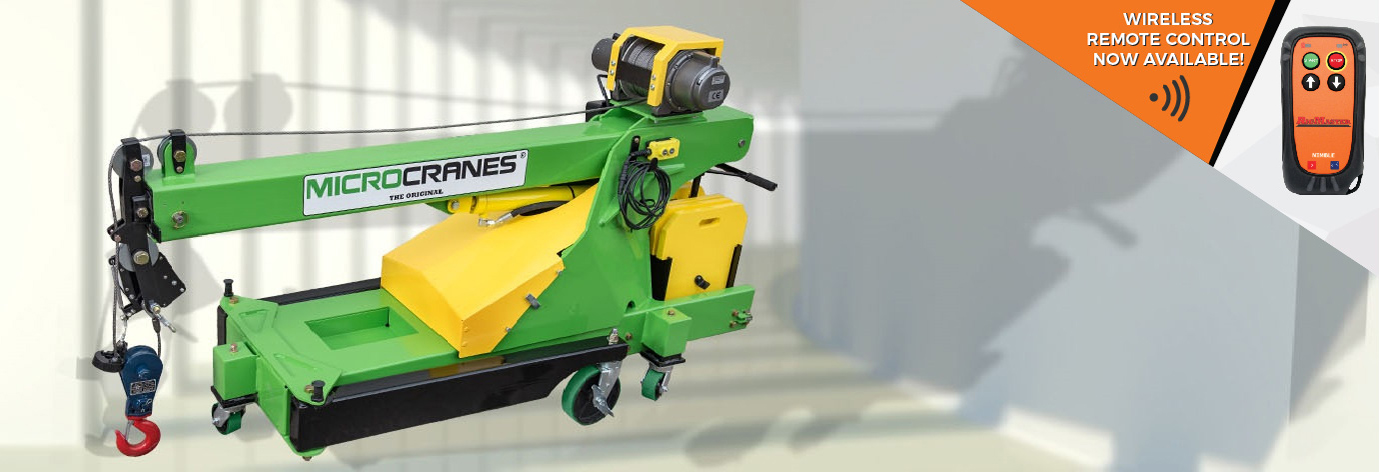
Microcranes® combine the functionality of portable lifting equipment, mobile lifting equipment, industrial lifting equipment, floor cranes, material handling equipment, and pick-and-carry lifting systems into one compact platform.
- 2,000 lb capacity: Lift heavy materials, equipment, machinery, and components with confidence.
- 27 ft lift height: Reach elevated work areas, mezzanines, rooftop openings, equipment platforms, and difficult access points.
- 135 ft lowering depth: Support utility structures, shafts, pits, tanks, below-grade projects, and multi-story lowering applications.
- Lightweight design: Approximately 1,800 pounds total machine weight.
- Pick-and-carry capability: Lift and transport materials with one machine.
- Rapid deployment: Move from storage to operation quickly.
- Battery or electric operation: Zero emissions and low sound for indoor environments.
- Doorway and elevator access: Reach areas larger lifting equipment often cannot.
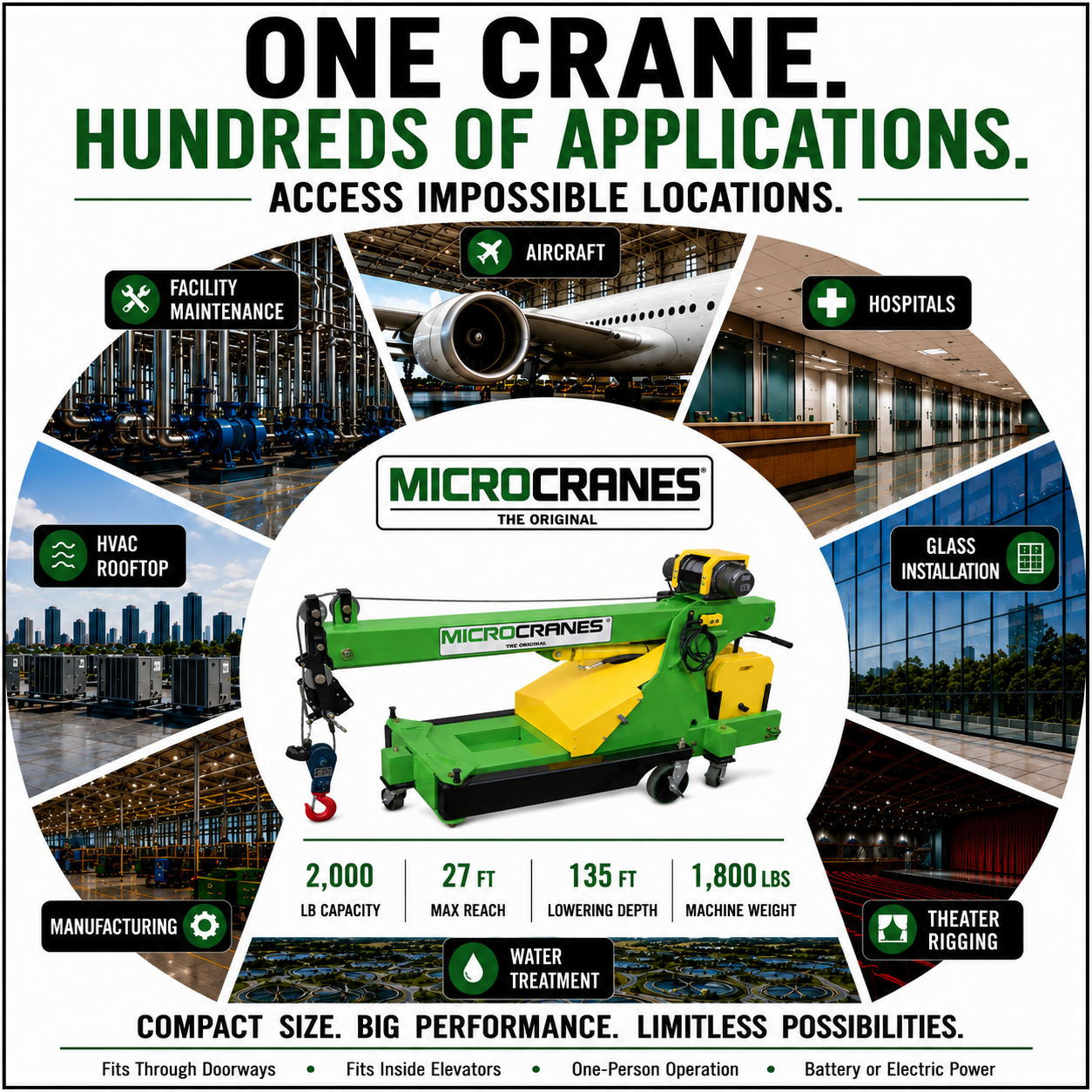
For many companies, Microcranes® become the missing piece in the material handling equipment fleet: a portable crane that works across departments, locations, applications, and job types.
The Strength-to-Weight Advantage
Most lifting equipment focuses only on capacity. The smarter question is often: how easily can the machine reach the job?
Many cranes weigh several thousand pounds. Many require trailers. Many require extensive setup. Many cannot fit through doors. Many cannot fit in elevators. Many cannot reach restricted-access work areas.
Microcranes® deliver a powerful strength-to-weight advantage:
- 2,000 lb lifting capacity
- 27 ft lift height
- 135 ft lowering depth
- Approximately 1,800 lb machine weight
This allows organizations to bring lifting capability directly to the work instead of forcing the work around large equipment.
That lightweight advantage matters in warehouses, rooftops, mezzanines, hospitals, elevators, mechanical rooms, commercial buildings, and industrial facilities where access and floor loading can be just as important as capacity.
Material Handling Equipment for Warehouses
Warehouse operations continue to evolve. Facilities are expected to process more inventory, improve throughput, increase safety, and maximize productivity while managing labor shortages and operational costs.
Warehouse managers focus on product flow, inventory management, equipment utilization, worker safety, throughput, labor efficiency, and facility uptime.
Forklifts remain essential. Conveyors remain essential. Robotics continue to expand. Yet warehouse maintenance teams still face lifting challenges every day.
Examples include conveyor motor replacement, gearbox replacement, mezzanine projects, rack repairs, building maintenance, HVAC upgrades, equipment installation, automation upgrades, electrical projects, dock equipment repair, and facility improvements.
Microcranes® provide warehouse lifting equipment capable of supporting these jobs without disrupting normal warehouse operations.
Instead of waiting for rental equipment or improvising with tools not designed for the lift, warehouse teams can deploy a compact portable crane directly to the work area.
Warehouse Lifting Equipment for Maintenance and Uptime
In warehouses and fulfillment centers, uptime is everything. A stopped conveyor can affect packing, sorting, shipping, receiving, and order fulfillment. A failed motor can create bottlenecks. A mechanical repair can slow an entire shift.
Microcranes® help warehouse maintenance teams respond faster by providing a mobile lifting equipment solution that can be stored on-site and moved into position when needed.
Common warehouse uses include lifting conveyor drives, replacing motors, installing small machinery, positioning electrical cabinets, moving maintenance parts, supporting mezzanine work, and assisting with facility upgrades.
This makes Microcranes® more than a crane. It becomes a productivity tool.
Material Handling Equipment for Distribution Centers
Distribution centers are becoming increasingly automated. Artificial intelligence, autonomous mobile robots, automated storage systems, smart logistics, predictive maintenance, and digital inventory management are reshaping the industry.
Yet every automated facility still requires equipment installation, maintenance, upgrades, and repairs.
Microcranes® support conveyor projects, robotics installations, facility maintenance, equipment replacement, automation upgrades, and infrastructure improvements.
Adaptive Material Handling™ provides the flexibility that automated systems often cannot.
Material Handling Equipment for Manufacturing
Manufacturing facilities depend on uptime. A failed motor can stop production. A damaged gearbox can create bottlenecks. A failed pump can impact entire processes.
Maintenance teams need lifting equipment that can quickly reach the problem and begin work.
Microcranes® support motors, pumps, process equipment, gearboxes, production machinery, conveyors, electrical equipment, industrial maintenance projects, and machine installation.
The result is faster response, reduced downtime, and more control over everyday lifting challenges.
Material Handling Equipment for Facility Management
Facility managers are responsible for maintaining building systems that support daily operations. Mechanical systems, electrical systems, HVAC systems, infrastructure, life-safety equipment, and building assets all require service over time.
Many of these systems involve heavy components that require lifting, lowering, positioning, and replacement.
Microcranes® provide facility management teams with a versatile lifting solution capable of supporting maintenance and capital improvement projects throughout the building.
Because Microcranes® can fit through doorways and elevators, they are especially useful in buildings where large forklifts or cranes are not practical.
The Labor Shortage Challenge
Across nearly every industry, organizations are being asked to accomplish more with fewer people. Experienced maintenance technicians are retiring. Skilled labor is harder to find. Facilities need tools that improve productivity.
Microcranes® help smaller teams accomplish larger tasks.
Instead of requiring multiple workers to manually handle materials, teams can utilize a purpose-built lifting system that improves efficiency and reduces physical strain.
This helps organizations do more with the personnel they already have.
The Cost of Waiting
Downtime is expensive. Waiting is expensive. Rental equipment is expensive. Scheduling delays are expensive. Contractor mobilization is expensive.
When equipment fails, every hour matters.
An Everyday Crane™ stored on-site can often eliminate delays associated with equipment rentals, contractor scheduling, emergency mobilization, temporary lifting systems, and improvised solutions.
The ability to respond immediately can create significant long-term value.
Where Traditional Equipment Falls Short
| Equipment | Primary Purpose | Limitation |
|---|---|---|
| Forklift | Move pallets | Limited reach and positioning |
| Pallet Jack | Floor transport | No lifting capability |
| Conveyor | Product flow | Fixed location |
| Robot | Repetitive tasks | Limited flexibility |
| Lift Table | Ergonomic positioning | Limited mobility |
| Overhead Crane | High-capacity lifting | Fixed coverage area |
| Microcranes® | Lift, lower, carry, position, and transport | Adaptable across hundreds of applications |
Microcranes® do not replace existing material handling equipment. They make existing material handling equipment more effective by filling the gaps that traditional systems leave behind.
Safety Through Controlled Lifting
Worker safety remains one of the most important goals of any material handling strategy. Manual lifting creates risk. Improvised lifting creates uncertainty. Purpose-built lifting equipment creates control.
Microcranes® help improve load control, precision positioning, material handling safety, maintenance safety, workflow efficiency, and equipment protection.
By helping reduce awkward manual lifting and uncontrolled handling methods, Microcranes® can support safer everyday material lifting operations.
Microcranes® are designed for material handling only. They are not personnel lifts.
Portable Lifting Equipment for Restricted Access
Many jobs are not difficult because of the load weight. They are difficult because of access.
The work may be inside a mechanical room, on a rooftop, down a hallway, inside a warehouse mezzanine, behind production equipment, inside a hospital, near a utility structure, or below grade.
Large lifting equipment may not fit. Forklifts may not reach. Overhead cranes may not cover the area.
Microcranes® provide portable lifting equipment for these restricted-access situations.
With a compact footprint, lightweight design, pick-and-carry capability, 27 ft lift height, and 135 ft lowering depth, Microcranes® help teams reach work areas that many traditional material handling solutions cannot access.
The Future of Material Handling
The future of material handling includes artificial intelligence, robotics, warehouse automation, smart facilities, autonomous transport, sustainable operations, electrification, and predictive maintenance.
However, no matter how advanced facilities become, there will always be equipment to install, maintain, relocate, upgrade, and repair.
That reality is why Adaptive Material Handling™ matters.
Automation moves products.
Microcranes® move possibility.
One Tool. Hundreds of Applications.
Microcranes® support warehouses, distribution centers, fulfillment centers, manufacturing plants, hospitals, data centers, airports, utilities, water treatment plants, wastewater facilities, commercial buildings, universities, government facilities, energy projects, solar installations, mechanical contractors, industrial maintenance teams, and facility management departments.
One machine can support maintenance in the morning, equipment installation in the afternoon, and facility upgrades the next day.
This multi-purpose value makes Microcranes® one of the most versatile additions to a modern material handling equipment fleet.
The Hidden Gem of Material Handling Equipment
Most facilities invest heavily in moving products. Far fewer invest in moving the equipment that keeps operations running.
That is why Microcranes® are often described as the hidden gem of material handling equipment.
They provide a unique combination of portable lifting equipment, material lifting equipment, industrial lifting equipment, mobile lifting equipment, pick-and-carry capability, rapid deployment, lightweight access, safety-focused operation, and everyday versatility.
Forklifts move pallets.
Conveyors move products.
Robots move inventory.
Storage systems organize materials.
Microcranes® move the equipment that keeps everything running.
When something heavy needs to be lifted, when something difficult needs to be positioned, and when something critical must be moved right now, Adaptive Material Handling™ delivers the flexibility traditional systems often lack.
Microcranes®: The Everyday Crane™ for Modern Operations.
Adaptive Material Handling™ Starts Here.
Frequently Asked Questions About Material Handling Equipment
What is material handling equipment?
Material handling equipment includes tools, machines, systems, and lifting devices used to move, store, protect, control, position, and manage materials inside warehouses, manufacturing plants, distribution centers, commercial buildings, and industrial facilities.
What are examples of material handling equipment?
Examples include forklifts, pallet jacks, conveyors, storage racks, carts, lift tables, hoists, cranes, robotic systems, automated storage systems, mobile lifting equipment, and portable lifting equipment.
What is portable lifting equipment?
Portable lifting equipment is lifting equipment that can be moved to the work area instead of being fixed in one location. Microcranes® are portable lifting equipment designed to lift, carry, lower, and position materials in multiple environments.
What is mobile lifting equipment?
Mobile lifting equipment is equipment that can move within a facility or jobsite while supporting lifting work. Microcranes® provide mobile lifting capability with pick-and-carry functionality.
What is an Everyday Crane™?
An Everyday Crane™ is a compact lifting solution kept available for routine lifting tasks, maintenance work, installation projects, emergency repairs, and restricted-access material handling challenges.
How do Microcranes® help warehouses?
Microcranes® help warehouses with conveyor maintenance, motor replacement, mezzanine work, rack repairs, HVAC upgrades, automation installation, equipment positioning, and facility maintenance.
Are Microcranes® material handling equipment?
Yes. Microcranes® are material handling equipment because they are designed to lift, lower, transport, carry, and position materials and equipment.
Are Microcranes® personnel lifts?
No. Microcranes® are designed for material handling only and are not personnel lifts.
Why is lightweight lifting equipment important?
Lightweight lifting equipment can be easier to transport, position, and deploy in restricted-access areas such as warehouses, rooftops, elevators, interior buildings, and mechanical rooms.
What makes Microcranes® different from traditional lifting equipment?
Microcranes® combine 2,000 lb capacity, 27 ft lift height, 135 ft lowering depth, lightweight design, pick-and-carry capability, and rapid deployment in one compact portable lifting system.
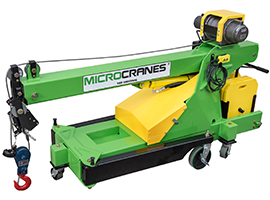
Compact Crane
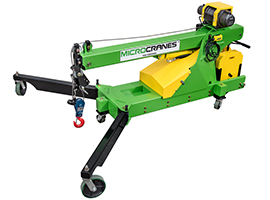
Outrigger Legs
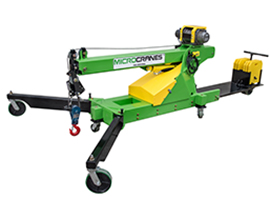
Counterweight Extended