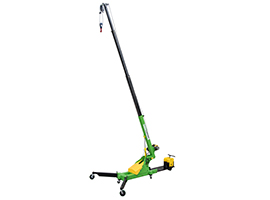


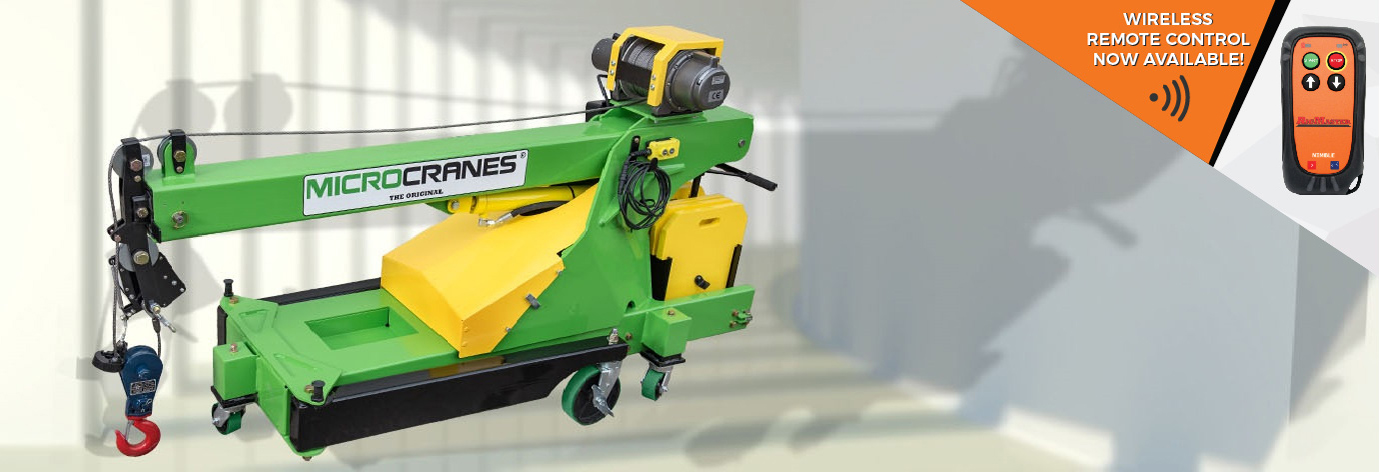
Telehandler vs Mini Crane: Compact Material Handling Built for Access
Telehandlers, forklifts, pallet jacks, tuggers, and industrial trucks are essential material handling tools. They move pallets, pull carts, support warehouses, serve loading docks, and help crews handle heavy materials across jobsites, plants, yards, and facilities.
But some material handling problems are not solved by simply moving a pallet.
Some jobs require compact lifting capability in a tight, narrow, indoor, rooftop, finished-floor, or restricted-access space. The challenge is not always maximum capacity. Sometimes the challenge is the path, the surface, the approval process, and the ability to place the load exactly where it belongs.
Microcranes® portable mini cranes are built for those jobs.
Microcranes® provides compact, hook-based material handling for applications where larger industrial vehicles may be too wide, too heavy, too disruptive, or unable to reach the work. It is an engineered lifting product designed to bring crane capability into places where forklifts, pallet jacks, tuggers, and telehandlers may fall short.
This is Adaptive Material Handling™ — bringing the right lifting tool to the work, instead of forcing the work to fit oversized equipment.
Microcranes® is built for access.
The Core Difference: Moving Materials vs Placing Materials
Most material handling equipment is designed to move materials.
A pallet jack moves palletized loads across a floor. A tugger pulls carts, trailers, and material trains. A forklift moves and stacks pallets. A telehandler moves heavy materials across outdoor jobsites and provides reach over rough terrain.
Those machines are valuable. But many jobs require more than movement. They require lifting, reaching, holding, positioning, and precise placement.
That gap appears when a crew needs to install or position:
- Pumps
- Motors
- Glass panels
- HVAC components
- Valves
- Fixtures
- Panels
- Tanks
- Filters
- Equipment skids
- Industrial parts
- Building materials
- Maintenance components
A pallet jack may move the load to the room. A forklift may unload it from the truck. A tugger may pull it through a facility. A telehandler may work outside. But the final challenge is often placing the load exactly where it belongs.
That is where a compact mini crane can become the missing material handling tool.
Microcranes® fills the gap between moving materials and placing materials in restricted-access spaces.
Where Microcranes® Fits in Material Handling
Microcranes® does not replace every industrial truck or material handling machine. It fills a specific access-driven lifting role.
Material Handling Equipment Comparison
| Equipment Type | Best Use | Where It Can Fall Short |
|---|---|---|
| Pallet Jack | Moves palletized loads across flat floors. | Limited lift height. No boom reach or hook placement. |
| Tugger | Pulls carts, trailers, and material trains. | Horizontal movement only. No lifting capability. |
| Forklift | Handles pallets, stacking, and loading docks. | Limited reach and tight-access performance. |
| Telehandler | Handles outdoor lifting and rough terrain work. | Large footprint. Difficult indoors or on sensitive surfaces. |
| Microcranes® Portable Mini Crane | Provides compact lifting, reach, and precise placement. | Not designed for high-capacity pallet handling. |
If the job is moving pallets, a pallet jack or forklift may be the correct tool. If the job is pulling carts, use a tugger. If the job is heavy outdoor material handling across rough terrain, use a telehandler.
If the job requires compact hook-based lifting, height, reach, and precise placement in a tight or difficult space, consider a Microcranes® portable mini crane.
What Is a Telehandler?
A telehandler, also called a telescopic handler or reach forklift, combines forklift-style material handling with a telescoping boom. Telehandlers are commonly used to lift, carry, and place materials across construction sites, yards, farms, industrial sites, and outdoor work areas.
Telehandlers are especially useful when a job requires rough-terrain travel, pallet handling, long forward reach, or lifting materials over obstacles. Many models accept forks, buckets, truss booms, work platforms, jibs, and other attachments.
For outdoor jobsites, framing, masonry, heavy pallet movement, agriculture, and rough-terrain construction work, a telehandler can be an excellent machine.
But a telehandler is still a large industrial vehicle. It may not be ideal for every building, surface, pathway, courtyard, rooftop, campus, park, public ground, or finished work environment.
What Is a Portable Mini Crane?
A portable mini crane is compact lifting equipment designed for controlled material handling in areas where larger cranes, forklifts, telehandlers, or industrial vehicles may not fit.
Unlike a forklift or pallet jack, a mini crane is not primarily a pallet-moving machine. Unlike a tugger, it is not simply a towing vehicle. Unlike a telehandler, it is not primarily a rough-terrain outdoor reach vehicle.
A mini crane is built around hook-based lifting, reach, height, access, and controlled placement.
Microcranes® portable mini cranes are designed for practical material lifting in restricted-access environments. They provide up to 2,000 lb lifting capacity, up to 27 ft lifting height, battery or electric operation, non-marking wheels, compact movement, and precise lifting control.
The goal is not to replace every telehandler, forklift, pallet jack, tugger, or industrial truck. The goal is to give contractors, facilities, utilities, installers, maintenance teams, property managers, and public-site operators a compact engineered lifting product for jobs where traditional material handling equipment is not enough.
Built for Access, Not Just Capacity
Many equipment comparisons focus only on maximum lifting capacity. But in real jobs, capacity is only one part of the decision.
A machine also has to reach the work.
It has to fit through the route.
It has to operate on the available surface.
It has to be approved for the site.
It has to avoid unnecessary damage, disruption, emissions, and setup complexity.
A machine with more capacity does not help if it cannot reach the lift point. A telehandler may be able to lift the load outdoors, but it may be too large for a courtyard, rooftop, interior corridor, finished floor, campus, public ground, or operating facility.
A forklift can move a pallet, but it may not help place a motor, pump, glass panel, valve, fixture, or equipment component into position.
A tugger can pull material, but it cannot lift it into place.
A pallet jack can move the load, but it cannot provide boom reach, hook control, or height.
That is where compact material handling equipment can make sense. Microcranes® is designed around access-first lifting. It brings crane-style material handling into tight, narrow, difficult, and restricted spaces where larger industrial vehicles may be impractical.
Telehandler vs Mini Crane: Simple Comparison
Telehandler vs Mini Crane Comparison Chart
| Job Need | Telehandler | Microcranes® Portable Mini Crane |
|---|---|---|
| Outdoor rough terrain | Strong fit | Best on hard surfaces |
| Heavy pallet movement | Strong fit | Not primary use |
| Fork-based handling | Strong fit | Not primary use |
| Hook-based lifting | Requires attachment | Core function |
| Indoor lifting | Often difficult | Strong fit |
| Finished floors | Often too heavy | Non-marking advantage |
| Narrow access | Often difficult | Compact advantage |
| Doorway or elevator access | Poor fit | Strong fit |
| Parks and campuses | May require approvals | Easier staging |
| Battery operation | Available on some models | Core advantage |
| Zero emissions | Available on some models | Core advantage |
| Precision placement | Moderate to strong | Strong fit |
| Rooftop work | Often difficult | Strong fit |
| Low-disruption setup | Requires planning | Compact and practical |
Compact, Small, Battery-Powered, and Narrow by Design
Microcranes® is designed for jobs where a smaller, more compact lifting machine can solve problems that larger equipment creates.
A compact footprint can help in narrow paths, finished buildings, utility rooms, plant aisles, rooftop access points, corridors, courtyards, elevators, sidewalks, and restricted work zones.
Battery or electric operation can help reduce emissions, noise, and indoor operating concerns. Non-marking wheels can help protect finished surfaces. Lightweight construction can help reduce the burden of moving, staging, and positioning equipment near the lift.
This matters because many lifting jobs are not in open construction yards. They happen inside existing buildings, around operating facilities, in public spaces, on hardscape, near landscaping, or in areas where equipment access must be controlled.
Microcranes® gives users compact crane capability without forcing every material handling problem into a forklift, telehandler, pallet jack, or tugger category.
When a Telehandler Is the Better Choice
- Outdoor rough-terrain operation
- Heavy pallet movement
- Long forward reach across a jobsite
- High-capacity lifting beyond compact crane requirements
- Frequent travel across uneven ground
- Fork-based material handling
- Large construction site productivity
When a Portable Mini Crane Is the Better Choice
- Compact access
- Small-footprint lifting
- Narrow access routes
- Indoor or finished-floor lifting
- Hook-based material handling
- Battery-powered or electric operation
- Zero-emission operation
- Low-noise work
- Elevator or doorway access
- Rooftop material lifting support
- Mechanical room access
- Public-site or campus access flexibility
- Glazing, HVAC, utility, or maintenance work
- Precise placement in restricted spaces
- Lower-disruption lifting
- Lightweight equipment deployment
- Adaptive Material Handling™
Telehandler vs Mini Crane Decision Checklist
Decision Checklist
| Question | If Yes, Consider |
|---|---|
| Need to move heavy pallets outdoors? | Telehandler |
| Working on rough terrain? | Telehandler |
| Need to lift over 2,000 lb? | Telehandler or larger crane |
| Moving pallets across a floor? | Pallet jack or forklift |
| Pulling carts or trailers? | Tugger |
| Need hook-based lifting? | Mini Crane |
| Working indoors or on finished floors? | Mini Crane |
| Access tight or restricted? | Mini Crane |
| Site restricts heavy equipment? | Mini Crane |
| Need zero-emission operation? | Mini Crane |
| Lightweight equipment required? | Mini Crane |
| Repeated compact lifts? | Mini Crane Ownership |
| Rental delays impacting work? | Mini Crane Ownership |
A Compact Alternative When a Telehandler Is Too Large
Telehandlers are excellent machines. But they are not always the most practical answer for every lift. In many facilities, plants, buildings, rooftops, parks, campuses, public grounds, and restricted-access jobsites, the challenge is not maximum outdoor capacity. The challenge is getting a lifting machine close enough to the work without creating new access, surface, or approval problems.
Microcranes® portable mini cranes are built for compact material handling where access, control, and practical deployment matter.
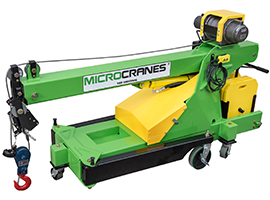
Compact Crane
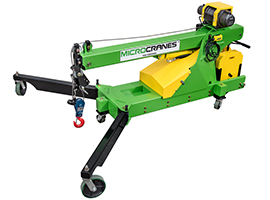
Outrigger Legs
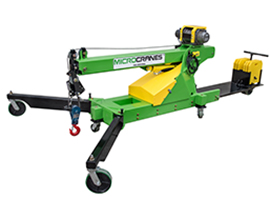
Counterweight Extended