

Microcranes®
Adaptive Material Handling™
Built for Access.
2,000 lb. Capacity. 27 ft Reach. Lightweight. Portable. Ready in Minutes.
Most lifting challenges are not caused by weight.
They are caused by access.
A failed motor on the 12th floor. A rooftop HVAC replacement. A pump located deep inside a water treatment facility. A generator installation inside an operating hospital. A transformer positioned in a restricted utility room.
The load may only weigh a few hundred pounds. The challenge is getting lifting capability to the work.
For decades, contractors and facility operators have relied on forklifts, chain falls, gantry cranes, davit systems, engine hoists, and large mobile cranes to solve these problems. While each has a place, today’s facilities demand a more flexible solution.
Microcranes® was engineered for a different reality.
Not bigger lifting. Better access.
The result is a new approach to lifting called Adaptive Material Handling™—bringing professional lifting capability directly to difficult-access locations where traditional equipment often struggles.
Whether operating in warehouses, manufacturing plants, hospitals, utility facilities, data centers, rooftops, mechanical rooms, aircraft hangars, or industrial maintenance environments, Microcranes® helps organizations solve lifting challenges safely, efficiently, and economically.
This is why Microcranes® has become known as The Everyday Crane™.
Most Jobs Are Not Limited by Capacity
They’re limited by access.
Many lifting projects face one or more of what we call:
The Five Access Barriers™
1. Weight
Can the equipment safely lift the load?
2. Height
Can the crane reach the work?
3. Distance
Can the load be positioned accurately?
4. Access
Can the crane physically get there?
5. Time
Can the work be completed quickly and economically?
Traditional lifting equipment often solves one or two of these challenges.
Microcranes® was designed to address all five.
This is the foundation of Adaptive Material Handling™.
Portable Cranes Are Changing Material Handling
Modern facilities are becoming more complex, more crowded, more vertical, more expensive to maintain, and more sensitive to downtime.
As a result, organizations are increasingly searching for portable lifting equipment capable of adapting to changing work environments.
Portable cranes provide advantages that many traditional lifting systems cannot.
Instead of bringing the work to the crane, portable cranes bring the crane to the work.
That distinction changes everything.
What Is a Portable Crane?
A portable crane is a compact lifting system designed to be transported, positioned, and operated in locations where larger cranes may be impractical or impossible to use.
Portable cranes are commonly used for material handling, equipment installation, industrial maintenance, warehouse operations, HVAC replacement, mechanical contracting, utility infrastructure, water treatment facilities, data centers, manufacturing operations, rooftop lifting, and renewable energy projects.
Portable cranes bridge the gap between traditional lifting equipment and the access challenges found in modern facilities.
The Access Equation™
Most lifting projects involve more than simply lifting a load.
They involve balancing:
Access + Safety + Speed + Labor + Cost
This is the Access Equation™.
The most productive lifting solution is rarely the largest crane.
It is the crane that reaches the work quickly, safely, and efficiently.
Microcranes® was built around this principle.
Why Facilities Choose Microcranes®
- Fits where larger cranes cannot
- Accesses rooftops
- Fits inside many elevators
- Moves through many standard doorways
- Deploys in minutes
- Supports one-person operation
- Operates indoors
- Produces zero emissions at point of use
- Offers battery or electric operation
- Supports hundreds of lifting applications
- Reduces dependence on larger crane rentals
- Improves maintenance productivity
- Increases lifting flexibility
- Helps reduce manual material handling
For many organizations, Microcranes® becomes one of the most utilized pieces of equipment in the facility.
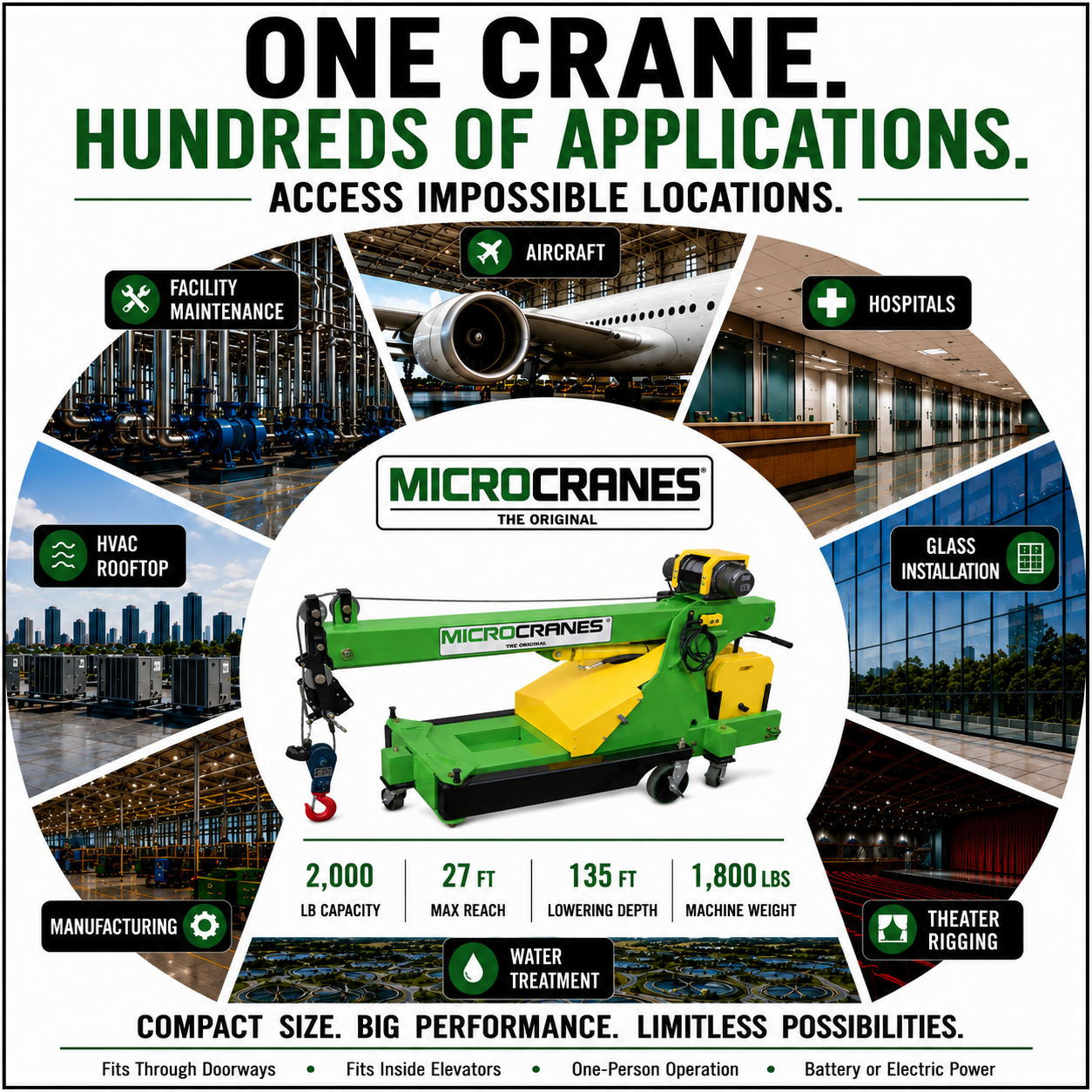
Microcranes® Portable Crane Specifications
Capacity
2,000 lb lifting capacityReach
Up to 27 ft lifting heightLowering Depth
Up to 135 ftMachine Weight
Approximately 1,800 lb.Power Options
- Battery powered
- Electric powered
Mobility
- Pick and carry capability
- Compact footprint
- Rapid deployment
Indoor Friendly
- Zero emissions at point of use
- Low sound operation
- Non-marking wheels
These specifications help create a portable crane that is uniquely suited for access-restricted environments.
Lift Up. Reach Out. Lower Down.
Many cranes focus only on lifting height.
Few focus on lowering depth.
Yet some of the most challenging projects involve lowering equipment below grade, below structures, or deep into facilities.
Examples include utility vaults, pump stations, water infrastructure, vertical shafts, mechanical pits, construction excavations, and underground facilities.
Microcranes® can lower loads up to approximately 135 feet.
That is nearly 13 stories of controlled lowering capability.
For many applications, lowering depth is just as important as lifting height.
Hundreds of Applications
One reason Microcranes® is known as The Everyday Lift™ is its versatility.
- Pumps
- Motors
- Gearboxes
- Compressors
- Generators
- Transformers
- Electrical panels
- Batteries
- HVAC units
- Chillers
- Air handlers
- Heat exchangers
- Pipe
- Structural steel
- Machinery
- Manufacturing tooling
- Conveyor systems
- Glass panels
- Solar equipment
- Utility equipment
- Mechanical assemblies
- Water treatment equipment
- Aircraft components
- Stage rigging equipment
- Building maintenance materials
- Mission-critical infrastructure
The list continues to grow as customers discover new applications whether needing a mini crane in California, Texas, Canada or Costa Rica.
Portable Cranes for Warehouses
Warehouse operators require flexible lifting equipment.
battery powered cranes help support conveyor maintenance, racking modifications, equipment installation, machinery service, and material handling projects.
Unlike fixed lifting systems, portable cranes move directly to the task.
Portable Cranes for Manufacturing
Manufacturing facilities depend on uptime.
Portable cranes help maintenance teams replace motors, install equipment, change tooling, relocate machinery, and support preventive maintenance.
The result is improved productivity and reduced downtime.
Portable Cranes for Hospitals
Hospitals require lifting equipment that can operate inside occupied facilities.
Microcranes® can support generator maintenance, mechanical upgrades, HVAC projects, infrastructure improvements, and equipment installation.
Battery and electric operation provide advantages where emissions and noise matter.
Materials only. Not intended for personnel lifting.
Portable Cranes for Data Centers
Mission-critical facilities cannot tolerate unnecessary downtime.
Microcranes® supports UPS systems, battery replacement, generator projects, cooling infrastructure, and electrical upgrades.
Rapid deployment helps crews complete projects efficiently while minimizing disruption.
Portable Cranes for Utilities and Water Infrastructure
Utilities face unique access challenges.
Portable cranes support transformer handling, pump replacement, valve installations, electrical infrastructure, water treatment projects, and renewable energy systems.
The ability to bring lifting capability directly to the work often improves both productivity and safety.
Portable Cranes for Aerospace and Aircraft Maintenance
Aircraft maintenance environments require precision, mobility, and access.
Portable cranes can assist with component handling, tooling support, equipment maintenance, hangar operations, and specialized lifting projects.
Compact dimensions and precise control make portable lifting equipment valuable in aviation environments.
Why Lightweight Matters
Many compact cranes weigh 4,000 to 8,000 pounds or more.
Microcranes® weighs approximately 1,800 pounds.
This lightweight design helps provide lower floor loading, improved rooftop access, easier transportation, reduced site impact, and greater deployment flexibility.
Being lighter often means reaching places heavier equipment cannot.
Access Economics™
The lowest-cost crane is not always the crane with the lowest purchase price.
The most economical crane is often the crane that arrives faster, requires fewer people, deploys quicker, reduces delays, improves productivity, and eliminates unnecessary rentals.
This is Access Economics™.
By reducing friction between the crane and the work, organizations often improve both operational efficiency and project economics.
Built for the Jobs Other Cranes Can’t Reach
Not the largest crane.
Not the heaviest crane.
Not the tallest crane.
The crane built for access.
The crane built for versatility.
The crane built for modern facilities.
The crane that helps crews solve lifting challenges in warehouses, hospitals, manufacturing plants, utility facilities, data centers, rooftops, water treatment plants, aircraft hangars, and industrial environments.
The crane that can become one of the most utilized pieces of equipment in an organization.
The Everyday Crane™.
The Future of Portable Cranes
Facilities are becoming more complex.
Labor is becoming more expensive.
Access is becoming more challenging.
Downtime is becoming more costly.
The future belongs to lifting equipment that can adapt.
Microcranes® was engineered for that future.
2,000 lb capacity.
27 ft reach.
135 ft lowering depth.
Approximately 1,800 lb machine weight.
Battery or electric powered.
Rapid deployment.
Adaptive Material Handling™.
Built for Access.
Need information in Spanish? Click here: Mini Gruas
Microcranes®
Compact Crane
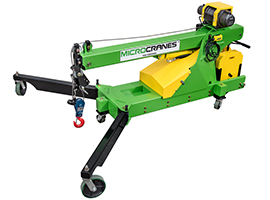
Outrigger Legs
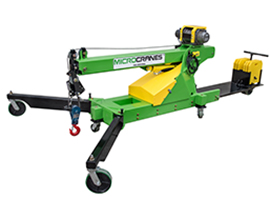
Counterweight Extended